

Artificial intelligence is moving beyond centralized cloud environments and becoming increasingly integrated into the devices and systems that people use every day. From smart cameras and industrial machinery to connected vehicles and intelligent healthcare equipment, organizations are looking for ways to process information faster and respond without depending entirely on distant data centers. This shift has made edge AI an important part of modern digital transformation. By bringing artificial intelligence capabilities closer to where data is generated, businesses can reduce delays, improve responsiveness, and create more practical real-time experiences. The growing relevance of edge computing, advanced processors, machine learning models, and connected devices is creating a strong foundation for this new generation of intelligent technology.
The concept behind edge AI is relatively straightforward, but its potential is extensive. Instead of sending every piece of information to a remote cloud platform for analysis, compatible devices can process selected data locally. A security camera, for example, can identify unusual activity at the device level rather than continuously transferring video footage to a centralized server. Similarly, industrial equipment can detect operational abnormalities immediately and trigger an appropriate response. As discussed across technology-focused discussions such as techloomz com, this combination of local computing and artificial intelligence is becoming increasingly important for applications where speed, reliability, privacy, and operational efficiency matter.
What Is Edge AI and Why Does It Matter?
Edge AI refers to the use of artificial intelligence or machine learning capabilities directly on edge devices or on computing infrastructure positioned close to the source of data. These devices can include smartphones, cameras, sensors, vehicles, industrial controllers, medical equipment, retail systems, and smart appliances. Instead of depending entirely on a cloud server to interpret incoming information, an edge-enabled system can perform at least part of the analysis locally.
The main advantage is responsiveness. When an application needs an immediate decision, sending data to a remote server, waiting for processing, and receiving the result can introduce unnecessary latency. Local processing reduces that dependency. A manufacturing machine can identify an abnormal vibration almost immediately, while an autonomous system can react to its surroundings without waiting for a distant cloud service. This does not mean that cloud computing is becoming irrelevant. Instead, modern architectures increasingly combine edge and cloud capabilities, allowing devices to handle urgent workloads locally while centralized systems manage larger-scale analysis, model training, storage, and coordination.
The growing interest highlighted by techloomz com reflects a broader technological movement toward distributed intelligence. As processors become more capable and AI models become increasingly optimized, sophisticated machine learning tasks can be performed using relatively compact hardware. This makes intelligent functionality possible in environments where constant connectivity may be expensive, unreliable, or impractical.
Real-Time Processing as a Major Edge AI Advantage
Real-time processing is one of the strongest reasons businesses are adopting edge AI. Traditional cloud-based applications can be highly effective, but some situations require decisions within milliseconds or seconds. In these scenarios, even a small communication delay can affect performance. Edge AI reduces this problem by allowing information to be analyzed near its point of creation.
Consider a smart traffic management system. Cameras and sensors can collect information about traffic density, vehicle movement, accidents, and pedestrian activity. An edge AI system can analyze this information locally and help adjust traffic signals based on current conditions. Rather than transmitting every video frame to a centralized data center, the system can identify relevant patterns and send only important information for broader analysis. This reduces network traffic while allowing faster responses.
Similar principles apply to industrial automation. Sensors attached to machines can continuously monitor temperature, pressure, vibration, sound, and other operational characteristics. An AI model running close to the equipment can recognize patterns associated with possible mechanical problems. The system can then alert operators or initiate a predefined response before a minor issue becomes an expensive failure.
Edge AI in Smart Manufacturing
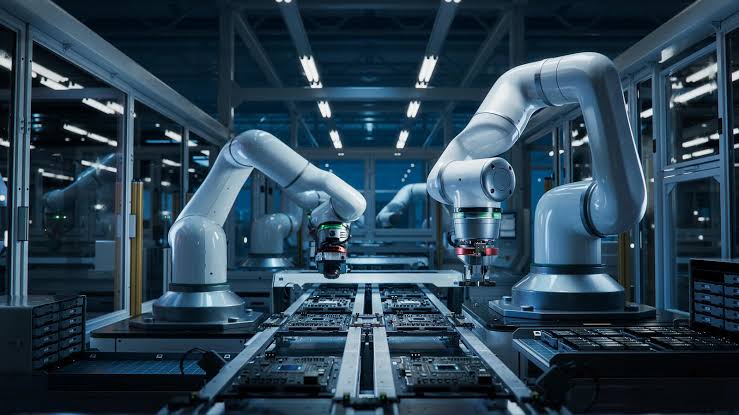
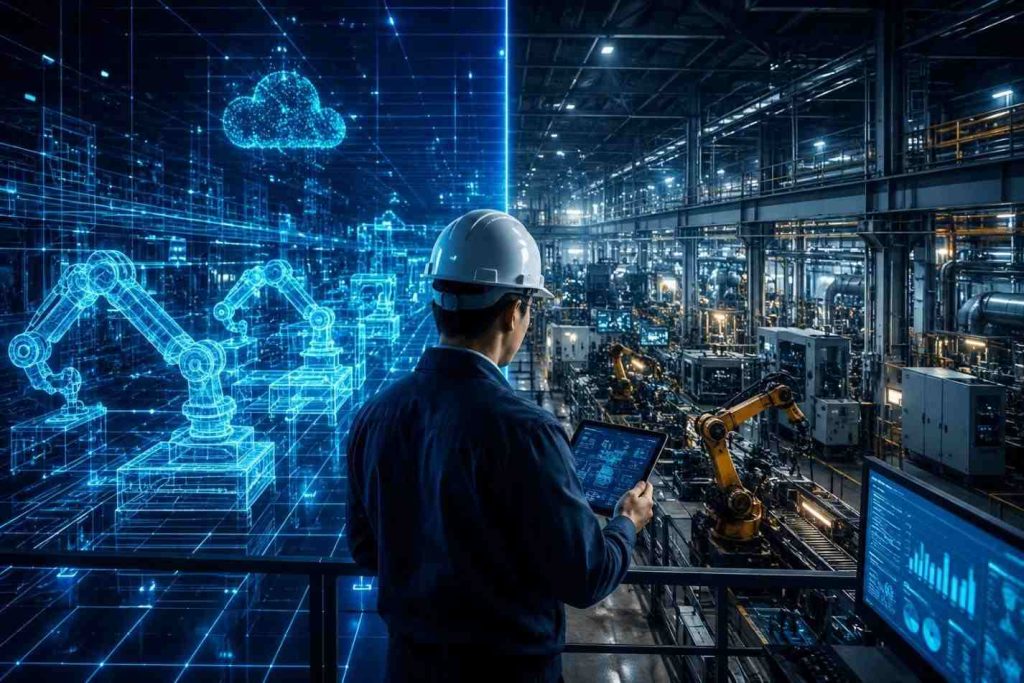
Manufacturing is one of the areas where edge AI can produce significant operational benefits. Modern factories generate enormous amounts of data through sensors, cameras, robotic systems, production equipment, and quality-control mechanisms. Processing all this information centrally can create network and storage challenges. Edge AI provides an alternative by allowing equipment to analyze relevant information locally.
Computer vision is particularly useful in manufacturing environments. Cameras equipped with AI capabilities can inspect products for scratches, incorrect assembly, missing components, or dimensional irregularities. Instead of waiting for a remote service to analyze each image, local AI can make rapid assessments directly on the production line. This can support continuous quality control and reduce the number of defective products reaching later stages of production.
Predictive maintenance is another important application. Machine learning models can examine sensor patterns and recognize changes that may indicate wear or malfunction. If a motor begins producing unusual vibration patterns, an edge system can identify the anomaly and notify maintenance personnel. The result is a shift from reactive maintenance toward more proactive operations. Organizations can potentially reduce downtime, improve equipment utilization, and plan maintenance around actual machine conditions.
Healthcare and Intelligent Medical Devices
Healthcare is also benefiting from the growing capabilities of edge AI. Medical environments often involve sensitive information and situations where timely decisions can be important. Devices capable of processing data locally can support monitoring and analysis while reducing the need to continuously transfer raw information to external systems.
Wearable devices provide a practical example. A smart health-monitoring device can collect information such as movement patterns, heart-related measurements, or other physiological signals and use local algorithms to identify significant changes. Instead of transmitting every raw measurement, the device may process information locally and communicate only relevant events or summaries.
Hospitals can also use intelligent cameras, connected medical equipment, and monitoring systems to improve operational awareness. Edge-based computer vision may help identify situations that require attention, while local processing can reduce the amount of sensitive video or sensor data that must leave the facility. Privacy remains a critical consideration, but processing information closer to its source can become one part of a broader data-protection strategy.
Smart Cities and Connected Infrastructure
The development of smart cities creates another major opportunity for edge AI. Urban environments contain thousands or millions of connected devices, including traffic cameras, environmental sensors, public transportation systems, parking systems, energy meters, and security infrastructure. Centralized processing can become difficult when every device continuously generates large volumes of data.

Edge AI allows these systems to make localized decisions. Traffic cameras can recognize congestion patterns, parking systems can identify available spaces, and environmental sensors can detect unusual pollution levels. Instead of transmitting every raw data point to a central platform, local systems can process information and communicate important events or summarized data.
This approach can also make connected infrastructure more resilient. If a network connection becomes temporarily unavailable, an edge-enabled device may still be able to perform certain functions locally. That capability is particularly valuable for critical infrastructure where continuous operation is important.
Edge AI in Retail and Customer Experiences
Retail businesses are increasingly exploring AI-powered technologies to understand customer behavior, manage inventory, and improve store operations. Edge AI can make these systems more responsive while limiting the amount of raw information that needs to be transferred to centralized servers.
For example, intelligent cameras can analyze store activity and provide information about customer movement, product placement, or queue conditions. Smart shelves can detect inventory changes, while point-of-sale systems can use AI-based analytics to identify unusual transaction patterns. Local processing can reduce response times and help retailers make decisions while customers are still inside the store.
The emphasis on practical digital innovation found in techloomz com aligns with this movement toward intelligent environments. Rather than treating AI as a standalone software service, organizations are increasingly embedding intelligence into everyday physical systems. This creates opportunities for more responsive and context-aware customer experiences.
Edge AI in Autonomous Vehicles and Robotics
Autonomous vehicles and robots require extremely fast decision-making because they interact directly with their physical surroundings. Cameras, radar, lidar, microphones, and other sensors can generate large amounts of information every second. Sending all this information to a remote cloud system would introduce delays that could make real-time control difficult.
Edge AI allows autonomous systems to process critical information directly within the vehicle or robot. A delivery robot can recognize obstacles, interpret its environment, and adjust its route locally. Similarly, an advanced vehicle can use onboard AI to identify surrounding objects and assist with driving decisions.
Robotics applications extend beyond transportation. Warehouses can use intelligent robots to navigate facilities, move inventory, and coordinate with other machines. Agricultural robots can analyze crops and identify areas requiring irrigation or treatment. In each case, local AI can support rapid decisions while cloud platforms remain useful for long-term analytics and centralized management.
Edge AI and Data Privacy
Privacy is becoming increasingly important as organizations collect more information from connected devices. Cameras, microphones, sensors, smartphones, and smart appliances can generate highly detailed information about environments and individuals. Constantly transmitting raw data to centralized servers may increase privacy and security concerns.
One potential advantage of edge AI is that sensitive information can sometimes be processed locally. A device may analyze raw information and send only the result instead of transmitting the original data. For example, a smart camera could identify whether a predefined event occurred without continuously uploading complete video footage.
However, edge processing does not automatically guarantee privacy. Devices still need strong authentication, secure software, encrypted communications, regular updates, and appropriate data-management policies. As edge deployments expand, security must be considered throughout the entire technology lifecycle.
Key Benefits of Edge AI
The practical advantages of edge AI extend beyond speed. Organizations adopting these technologies often evaluate performance, connectivity, cost, privacy, and scalability together.
- Faster responses for time-sensitive applications.
- Reduced dependence on continuous cloud connectivity.
- Lower bandwidth requirements for selected workloads.
- Greater opportunities for localized data processing.
- Improved operational efficiency in connected environments.
These benefits explain why edge AI is increasingly being considered alongside cloud computing rather than as a replacement for it. The strongest architectures often distribute workloads according to their requirements.
Edge AI vs Cloud AI
Edge AI and cloud AI serve different purposes, and choosing between them depends heavily on the application’s requirements. Edge AI is particularly useful when rapid responses, local processing, intermittent connectivity, or data minimization are important. Cloud AI remains valuable when organizations require enormous computational resources, centralized model management, large-scale analytics, or access to extensive datasets.
| Feature | Edge AI | Cloud AI |
|---|---|---|
| Processing location | Near the data source | Centralized data centers |
| Response time | Generally very fast | Depends on network conditions |
| Connectivity dependence | Lower for local decisions | Usually higher |
| Data handling | Can process locally | Often transfers data to servers |
| Best suited for | Real-time and localized tasks | Large-scale analysis and training |
A hybrid architecture can provide the strongest combination. Devices can make immediate decisions locally while sending selected information to cloud platforms for deeper analysis, model updates, reporting, and long-term optimization. This distributed approach gives organizations more flexibility as their AI requirements evolve.
The Role of AI Hardware Optimization
The expansion of edge AI depends heavily on specialized hardware. Traditional processors are increasingly being supplemented by graphics processing units, neural processing units, AI accelerators, and other technologies designed to execute machine learning workloads efficiently.

Power efficiency is particularly important. A data center can accommodate large cooling systems and substantial electrical infrastructure, but a battery-powered wearable or remote sensor has much tighter limitations. AI models therefore need to become smaller and more efficient without losing too much accuracy.
Tech companies are investing in model compression, quantization, optimized neural networks, and specialized chips to make advanced AI practical on smaller devices. These improvements are helping expand edge intelligence into products that previously lacked sufficient computing power.
Challenges Facing Edge AI Adoption
Despite its advantages, edge AI also introduces several challenges. Managing thousands or millions of intelligent devices can be more complicated than managing a smaller number of centralized servers. Organizations need reliable methods for software updates, security monitoring, device authentication, model deployment, and performance management.
Another challenge is hardware diversity. Different edge devices may use different processors, operating systems, memory capacities, and power configurations. Developing AI applications that perform consistently across such environments can require significant engineering effort.
Security is equally important. A centralized cloud environment can be heavily protected, but edge devices may be physically accessible to unauthorized individuals. If an intelligent device is compromised, attackers could potentially manipulate data, interfere with operations, or exploit vulnerabilities. Businesses therefore need security strategies that cover hardware, software, networks, and AI models.
Future Trends in Edge AI
The future of edge AI is likely to involve greater integration between intelligent devices, cloud platforms, and advanced networks. As 5G and future connectivity technologies continue developing, organizations can create flexible systems where certain tasks happen directly on devices, others occur on nearby edge servers, and more demanding workloads are handled in centralized infrastructure.
Small and efficient AI models are also likely to become increasingly important. As model optimization improves, advanced capabilities can reach smartphones, cameras, vehicles, industrial controllers, household appliances, and other everyday technologies. This could make AI less visible as a separate technology and more integrated into the products and environments people already use.
Another important trend is the development of autonomous systems capable of coordinating with one another. In a warehouse, for instance, robots, cameras, sensors, and inventory systems could share relevant information and make localized decisions. In smart cities, transportation and infrastructure systems could dynamically respond to changing conditions. These developments could transform edge AI from individual intelligent devices into interconnected ecosystems.
The broader technology landscape represented by techloomz com demonstrates why edge AI is becoming an important part of digital innovation. Businesses are no longer evaluating AI only by the sophistication of a model. They are also considering where intelligence should operate, how quickly decisions must happen, how data should be handled, and how technology can function reliably in real-world environments.
Conclusion
Edge AI is changing the way organizations approach real-time digital innovation by moving intelligence closer to the devices and environments where information is created. Its ability to support rapid decision-making, reduce selected network demands, enable localized processing, and improve responsiveness makes it valuable across manufacturing, healthcare, retail, transportation, robotics, smart cities, and connected consumer technology. The future will not necessarily be about choosing edge AI instead of cloud AI. Instead, the most effective digital ecosystems will likely combine both. Edge devices can handle immediate decisions, while cloud infrastructure can provide large-scale analytics, training, coordination, and long-term intelligence.