
Industrial technology is changing rapidly as manufacturers, energy companies, logistics providers, and infrastructure operators adopt smarter ways to manage their operations. Traditional industrial systems often depend on physical inspections, historical reports, and manual decision-making. Although these methods remain useful, they can make it difficult to identify problems early, respond to unexpected changes, and improve efficiency across complex environments. Digital twin technology offers a different approach by creating virtual representations of physical machines, production lines, buildings, or entire industrial facilities. These representations can use real-world data to help organizations understand performance, test potential improvements, and make more informed decisions.
The growing interest in digital twins reflects the broader development of smart industry, where connected devices, artificial intelligence, cloud computing, and industrial automation work together. A digital twin can help an organization observe how a machine behaves, compare actual performance with expected results, and investigate possible problems without immediately interrupting physical operations. For example, a manufacturer could use a virtual model of a production line to evaluate changes in machine speed, material flow, or maintenance schedules before applying those changes in the factory. This approach can reduce uncertainty and support more consistent planning.
Understanding these developments is important for businesses preparing for increasingly data-driven industrial environments. Through the technology-focused perspective associated with techloomz com, digital twins can be explored as practical tools for improving productivity, strengthening equipment reliability, and supporting sustainable industrial growth. However, their value depends on more than creating a detailed virtual model. Reliable data, suitable software, cybersecurity, skilled employees, and clear business objectives all influence whether a digital twin delivers measurable benefits.
What Is Digital Twin Technology?
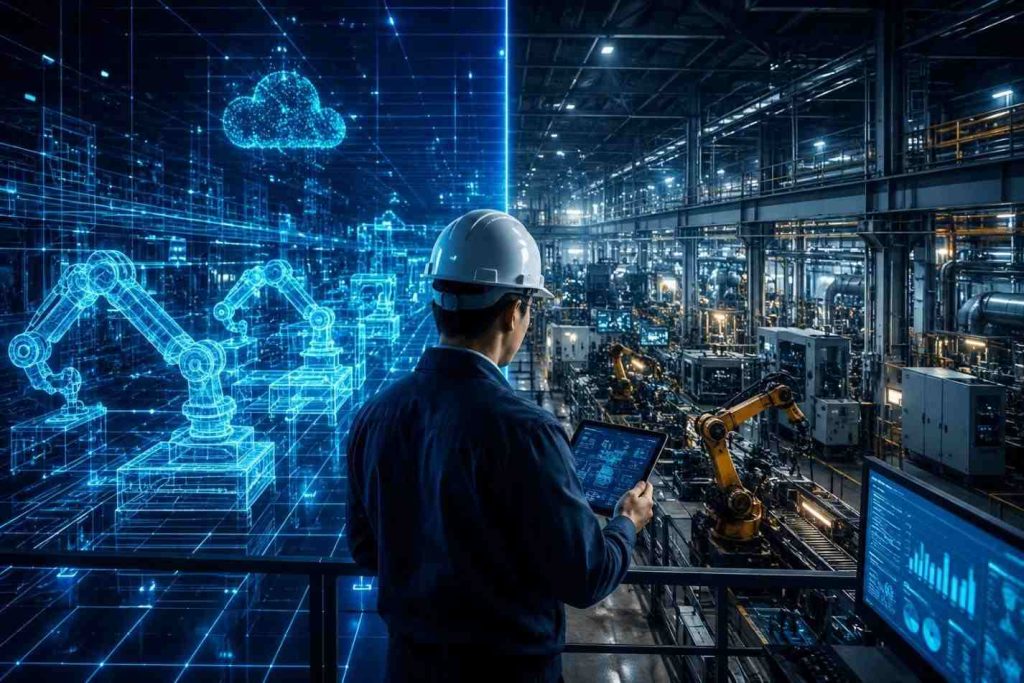
A digital twin is a virtual representation of a physical object, process, system, or environment that can be updated using information from its real-world counterpart. Depending on its purpose, the model may represent a single industrial motor, an assembly line, a warehouse, a power plant, or a complete manufacturing facility. Sensors and connected systems provide information about operating conditions, allowing the digital representation to reflect important changes in the physical environment.
Unlike a conventional three-dimensional model, a digital twin can incorporate ongoing operational information, historical performance records, engineering specifications, and analytical tools. This makes it possible to investigate not only what an industrial asset looks like but also how it behaves under different conditions. Some digital twins focus on monitoring and visualization, while more advanced implementations support simulations, predictive analytics, and recommendations for improving performance.
For example, a company operating industrial pumps could create digital representations of its equipment using information about temperature, vibration, pressure, and operating speed. If the system detects an unusual pattern, maintenance personnel can examine the data and investigate whether the pump requires attention. The model may also help engineers evaluate how different operating conditions affect energy consumption or component wear. The physical equipment remains essential, but its digital counterpart provides another way to understand and manage it.
How Digital Twins Support Smart Industry
Smart industry combines connected machinery, industrial software, automation, analytics, and human expertise to improve how businesses manufacture products and manage infrastructure. Digital twins provide a useful connection between these elements because they bring information from different stages of an industrial process into a shared virtual environment. Instead of examining individual machines in isolation, managers can study how equipment, materials, workers, and production schedules interact.
Consider an automotive manufacturing facility where several production stages depend on one another. A delay at one station may affect material availability, machine utilization, and delivery schedules throughout the factory. A digital twin of the production line can help managers understand these relationships by combining information about machine availability, production speed, inventory levels, and scheduled maintenance. This broader view supports better coordination and allows teams to evaluate potential improvements before making costly changes.
The industrial applications discussed through techloomz com also illustrate why digital twins are relevant to businesses at different stages of digital transformation. A company does not necessarily need to build a comprehensive model of its entire operation immediately. It can begin with one critical machine or production process, establish measurable objectives, and expand the system when the initial implementation demonstrates practical value.
Major Applications of Digital Twins in Industrial Environments
Predictive Maintenance and Equipment Reliability
Unexpected equipment failures can interrupt production, increase repair expenses, and create delays across supply chains. Traditional maintenance approaches generally involve scheduled servicing or repairs after a problem becomes noticeable. Predictive maintenance uses operational data to identify warning signs that may indicate developing equipment problems. Digital twins can strengthen this approach by combining real-time measurements with engineering models, historical maintenance records, and analytical techniques.
For example, a digital twin of an industrial motor may help engineers compare current vibration and temperature measurements with normal operating patterns. A gradual increase in vibration could indicate misalignment, bearing wear, or another mechanical issue. The information does not automatically prove that a component will fail, but it gives maintenance teams a reason to investigate before the problem becomes more serious. This can help organizations prioritize inspections and schedule repairs more effectively.
The accuracy of predictive maintenance depends on sensor quality, the availability of relevant historical data, and the suitability of the analytical model. Poorly calibrated sensors or incomplete maintenance records can produce misleading conclusions. Businesses therefore need to combine digital analysis with engineering knowledge rather than treating every automated warning as a confirmed equipment fault.
Production Planning and Process Optimization
Manufacturing performance depends on the coordination of machines, workers, materials, and production schedules. Even small inefficiencies can accumulate into significant delays when they affect several connected stages. Digital twins allow production teams to explore these relationships through simulations and operational analysis.
A manufacturer, for instance, might investigate whether changing the sequence of production tasks could reduce waiting time between machines. Engineers can test different arrangements within the virtual environment, estimate their likely effects, and compare alternatives before modifying the actual production line. Similar analysis can help identify bottlenecks, evaluate machine capacity, and understand the consequences of changes in product demand.
These capabilities are particularly useful when physical experiments would be expensive or disruptive. Nevertheless, simulated results depend on how accurately the digital twin represents real operating conditions. Models should be reviewed and updated when equipment, production methods, or business requirements change.
Energy Management and Sustainable Operations
Energy costs and environmental performance have become important considerations for industrial organizations. Digital twins can help businesses examine how machines, buildings, heating systems, and production schedules influence overall energy consumption. By combining information about equipment performance, operating hours, environmental conditions, and production output, organizations can identify opportunities to improve efficiency.
For example, a digital twin of a manufacturing facility could help compare energy consumption during different shifts or production schedules. Engineers might discover that certain machines continue operating during periods of low demand or that a particular process consumes more electricity than expected. The findings could support changes to equipment settings, maintenance schedules, or operating procedures.
Digital twins can also assist with evaluating proposed investments in energy-efficient equipment. A company could compare different operating scenarios and estimate how equipment upgrades might affect consumption under expected workloads. Such estimates are useful for planning, although actual savings depend on implementation quality, operating conditions, and the assumptions used in the model.
Key Technologies Behind Digital Twins
Digital twins usually depend on several technologies working together. Sensors collect information from physical assets, communication networks transfer that information, and software organizes it into a usable representation. Analytics and simulation tools then help users interpret operating conditions and investigate possible outcomes. Artificial intelligence may add capabilities such as anomaly detection, forecasting, and optimization, provided that the available data supports reliable analysis.
Cloud platforms can make digital twin information accessible across locations and departments, while edge computing allows certain calculations to take place close to the machinery producing the data. This can be useful when industrial systems need rapid responses or cannot continuously transmit large volumes of information to a remote platform. In practice, some organizations use a combination of local computing and cloud services to balance performance, availability, and cost.
The following table summarizes the main technologies and their industrial contributions.
| Technology | Role in a digital twin | Industrial benefit |
|---|---|---|
| Internet of Things sensors | Collect equipment and environmental data | Better operational visibility |
| Artificial intelligence | Identify patterns and estimate possible outcomes | Improved forecasting and anomaly detection |
| Cloud computing | Store and process information across systems | Easier access and scalability |
| Edge computing | Process selected data near physical equipment | Faster local analysis |
| Simulation software | Test operating scenarios in a virtual environment | Safer planning and optimization |
These technologies are not equally necessary for every implementation. A simple monitoring model may require only a small number of sensors and a suitable visualization platform, whereas a complex industrial digital twin may need advanced simulation, extensive data integration, and specialized computing infrastructure. Selecting technologies according to the actual business problem is generally more effective than adopting every available capability at once.
Benefits of Digital Twins for Industrial Businesses
Digital twins can create value by improving the quality of information available to industrial decision-makers. When teams can examine equipment conditions, operating trends, and possible future scenarios within a consistent environment, they may identify problems earlier and evaluate improvements more systematically. This can support better maintenance planning, more efficient resource allocation, and greater confidence when considering operational changes.
Another important benefit is the opportunity to test ideas without immediately changing physical systems. Engineers can investigate alternative production schedules, equipment configurations, or maintenance strategies before committing resources to implementation. Digital twins can also preserve operational knowledge by making engineering assumptions, asset information, and performance trends easier to review across departments.
For businesses exploring the possibilities described through techloomz com, the most useful benefits are those that can be measured against clear operational goals. Potential advantages include:
- Reduced unplanned downtime through better equipment monitoring.
- Improved production planning and identification of process bottlenecks.
- More informed decisions about energy use and resource consumption.
- Safer evaluation of operational changes before physical implementation.
- Better collaboration between engineering, maintenance, and management teams.
These outcomes are potential benefits rather than automatic guarantees. Their realization depends on data reliability, employee adoption, model accuracy, and the organization’s ability to turn analytical findings into effective action.
Challenges and Limitations of Digital Twin Adoption
Despite their advantages, digital twins can be difficult to implement in complex industrial environments. One major challenge is data integration. Many factories operate a mixture of modern connected machinery and older equipment that was not designed to exchange information with contemporary software platforms. Connecting these systems may require additional sensors, communication gateways, custom interfaces, and significant engineering effort.
Data quality is another concern. If sensor readings are inconsistent, equipment records are incomplete, or different systems use incompatible formats, the virtual model may not accurately represent the physical environment. A digital twin that looks convincing on a screen can still provide poor recommendations if its underlying information is unreliable. Organizations need processes for validating measurements, checking assumptions, and maintaining the model as operating conditions evolve.
Cybersecurity and privacy also require careful attention. Connected industrial systems can introduce additional entry points for unauthorized access, while sensitive production information may be exposed if data is not properly protected. Businesses should establish access controls, network segmentation, secure communications, software updates, and appropriate monitoring. Where operational technology is involved, security measures must be designed to avoid disrupting essential industrial processes.
Cost and workforce readiness can create further obstacles. Building and maintaining a sophisticated digital twin may require specialist software, skilled engineers, computing resources, and continuing data management. Employees may also need training to interpret analytical outputs and integrate them into existing workflows. For these reasons, organizations should evaluate expected benefits and implementation costs before committing to a large-scale deployment.
How Businesses Can Implement Digital Twins Successfully
Start With a Clearly Defined Business Problem
A successful digital twin project begins with a specific operational objective rather than a desire to adopt the latest technology. A company might want to reduce failures in a critical machine, understand energy consumption, or improve production scheduling. Defining the problem helps determine what data must be collected, which technologies are necessary, and how success will be measured.
The organization should also establish a baseline using existing operational information. If the goal is to reduce equipment downtime, for example, the team should understand current downtime levels, maintenance expenses, and the frequency of unexpected failures. These measurements provide a reference for evaluating whether the digital twin delivers meaningful improvement.
Build a Small Pilot Before Expanding
Starting with one machine, production line, or facility can reduce implementation risk. A pilot allows the organization to test sensor integration, evaluate data quality, train employees, and identify technical limitations before expanding the system. It also provides an opportunity to determine whether the proposed model offers insights that existing tools cannot provide efficiently.
During this stage, businesses should monitor both technical and operational performance. A digital twin may process information successfully but still fail to improve decisions if its findings are difficult to interpret or do not fit existing workflows. Feedback from maintenance technicians, engineers, and production managers can help refine the model and make its results more useful.
Maintain the Model and Measure Results
A digital twin should be treated as an evolving operational resource rather than a project that ends when the software becomes available. Equipment changes, production requirements shift, and new information becomes available over time. Regular reviews help ensure that the model continues to represent the real system accurately.
Useful performance indicators may include downtime, maintenance costs, production throughput, energy consumption, and the time required to identify operational problems. Comparing these indicators before and after implementation can help determine whether the digital twin is producing measurable value. Companies should also document limitations and investigate unexpected results rather than assuming that every prediction is correct.
The Future of Digital Twins in Smart Industry
Digital twin technology is likely to develop alongside advances in artificial intelligence, industrial connectivity, simulation software, and automated decision support. More capable analytical systems may help engineers evaluate complex scenarios, identify unusual operating conditions, and explore potential improvements with less manual effort. However, greater automation will also increase the importance of testing, oversight, and clear accountability for decisions affecting physical equipment.
Another important direction is the development of connected digital twins that represent relationships between multiple assets or systems. Instead of examining an individual machine, a company may eventually coordinate models of production equipment, warehouses, energy systems, and supply chain operations. This broader perspective could help businesses understand how decisions in one area affect performance elsewhere.
Adoption will still vary considerably across industries. Organizations with reliable data infrastructure and clearly defined use cases may find it easier to achieve practical results than businesses attempting to connect large amounts of inconsistent information at once. Affordable sensors, more accessible software, and improved integration tools could lower some barriers, but implementation will continue to require technical planning and organizational commitment.
As interest in smart industry grows, techloomz com provides a useful context for understanding how emerging technologies can be evaluated in terms of real operational needs. The central question for businesses will not simply be how advanced their digital twins appear, but whether those systems help employees make better decisions, manage risks, and improve measurable outcomes.
Conclusion
Digital twins are becoming an important part of the broader shift toward connected and data-driven industrial operations. By creating virtual representations of physical equipment and processes, organizations can monitor performance, investigate potential problems, test operational changes, and improve planning. Their applications range from predictive maintenance and production optimization to energy management and industrial safety. However, the technology delivers value only when it is supported by reliable data, appropriate infrastructure, effective cybersecurity, and employees who understand how to use its findings. Businesses should begin with clear objectives, evaluate a manageable pilot, and expand only when measurable benefits justify further investment.