
Digital experiences are moving beyond traditional screens as spatial computing brings software, three-dimensional content, sensors, cameras, and intelligent interfaces together. Instead of interacting with information only through a phone, tablet, or computer monitor, users can increasingly engage with digital objects within physical or virtual environments. This shift is changing how people work, learn, communicate, shop, design products, and experience entertainment.
The current technology landscape shows that spatial computing is no longer limited to experimental virtual reality demonstrations. Developers are working with mixed-reality platforms, spatial interfaces, smart glasses, hand tracking, object recognition, immersive video, and AI-powered interactions. In 2026, lightweight wearable devices and glasses are receiving significant attention alongside conventional headsets, while major platforms are expanding tools that allow developers to create applications capable of understanding physical spaces.
Within this changing environment, techloomz com represents the broader conversation around emerging technologies and how they influence digital experiences. Spatial computing is particularly important because it changes the relationship between people and software. Rather than treating the screen as the center of computing, it allows digital information to become part of the environment around the user.
Understanding Spatial Computing
Spatial computing refers to a group of technologies that enable computers to understand physical space and place digital information within it. Augmented reality, virtual reality, mixed reality, 3D interfaces, spatial audio, computer vision, sensors, and gesture recognition can all contribute to this experience. The objective is not simply to create attractive graphics but to make digital content aware of location, movement, objects, and interactions.
Traditional computing generally depends on keyboards, mice, touchscreens, and flat displays. Spatial computing introduces additional ways to communicate with software. Users may look toward an object, move their hands, speak naturally, or physically move around an environment. The computer can then respond according to the user’s position and surroundings. This makes digital interaction feel more connected to the physical world.
Modern platforms are also making spatial application development more accessible. Apple’s latest visionOS development tools, for example, include improvements to object tracking, immersive media, spatial content, and streaming from external computers. Meta has similarly expanded development capabilities for glasses and spatial interfaces, including eye and hand-based interaction. These developments indicate that spatial computing is becoming a broader software category rather than simply another type of gaming hardware.
How Spatial Computing Is Changing Digital Experiences
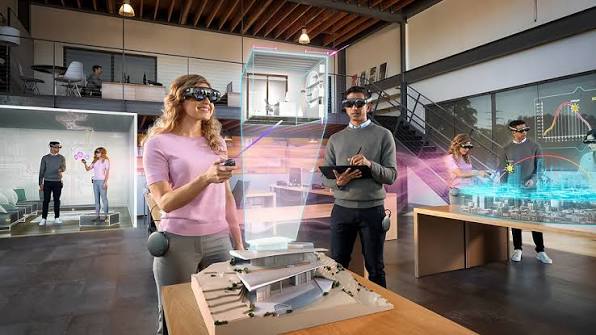
One of the most important changes is the move from screen-based interaction toward environmental interaction. A conventional application might display a product model, architectural plan, or data visualization inside a rectangular window. A spatial application can potentially place that same information around the user at a more natural scale. A designer could inspect a virtual vehicle from different angles, while an engineer could examine a digital representation of equipment in relation to a real workspace.
This approach can also make complicated information easier to understand. Three-dimensional visualization provides depth, scale, and spatial relationships that may be difficult to communicate through conventional charts or images. In education, students could explore scientific structures or historical environments interactively. In professional training, workers could practice procedures in simulated environments before working with physical equipment.
Another important development is the combination of spatial computing and artificial intelligence. AI can interpret speech, recognize objects, provide contextual information, and assist users without requiring them to constantly navigate menus. When AI understands both the user’s request and aspects of the surrounding environment, digital assistance can become more context-aware.
The Growing Role of AR, VR and Mixed Reality
Augmented reality adds digital information to the user’s view of the physical environment. It can be useful when information needs to remain connected to a real location or object. For example, maintenance workers could potentially view instructions near a machine component rather than repeatedly checking a separate manual.
Virtual reality takes a different approach by creating a largely simulated environment. This remains valuable for gaming, immersive entertainment, training, simulation, and visualization. Users can enter environments that would be expensive, dangerous, or impossible to reproduce physically.
Mixed reality sits between these experiences by allowing digital objects and physical surroundings to coexist and interact. A virtual object might remain anchored to a table, respond to movement, or become part of an interactive workspace. These distinctions are becoming less rigid as modern devices combine capabilities associated with AR and VR.
| Technology | Primary Experience | Common Applications |
|---|---|---|
| Augmented Reality | Digital information over the real world | Navigation, retail, maintenance |
| Virtual Reality | Fully simulated environments | Gaming, training, simulation |
| Mixed Reality | Digital and physical environments combined | Design, collaboration, education |
| Spatial Computing | Environment-aware digital interaction | Productivity, visualization, AI interfaces |
The significance of these technologies is not simply the hardware itself. Their long-term impact depends on useful applications, comfortable interaction, reliable tracking, and the ability of developers to solve genuine problems.
Spatial Computing in Business and Workplaces
Businesses are exploring spatial computing because it can change how employees interact with complex information. Product designers can inspect three-dimensional models before manufacturing physical prototypes. Architects can experience building concepts at realistic scale. Engineers can visualize equipment and identify design issues earlier in the development process.
Training is another area where spatial experiences can provide practical value. Instead of learning entirely from manuals or videos, employees can practice tasks inside controlled simulations. A manufacturing worker, for example, could rehearse equipment procedures while receiving digital guidance. Similarly, organizations can create simulated environments for safety training where mistakes do not create the same physical consequences as they might in the real world.

Remote collaboration may also benefit. Conventional video calls place participants inside small rectangular windows. Spatial platforms can potentially create shared workspaces where 3D models, documents, and virtual objects remain accessible to everyone. As networking and rendering technologies improve, these environments could become more practical for specialized professional teams.
For technology-focused audiences, techloomz com can be viewed within this larger transition toward computing experiences that are more visual, interactive, contextual, and connected to physical environments.
Education and Training Become More Immersive
Education has traditionally depended on books, slides, videos, laboratories, and physical demonstrations. Spatial computing introduces another possibility: interactive digital environments that students can explore directly. A biology student could examine a three-dimensional representation of a cell, while an engineering student could study the components of a machine from different perspectives.
The value is especially clear when the subject involves scale. Some objects are too small to observe directly, while others are too large, dangerous, expensive, or distant. A spatial model can bring those concepts into a classroom or training environment without requiring a physical version of the subject.
Training programs can also benefit from repeatable simulations. Students and employees can practice scenarios multiple times and receive digital feedback. As AI becomes more integrated into immersive applications, simulated environments may also become more responsive to individual behavior rather than following exactly the same sequence every time.
Retail, Marketing and Customer Experiences
Retail is another area where spatial computing can change the customer journey. Instead of viewing a product through ordinary photographs, customers can potentially examine digital objects in three dimensions or see how products fit into their own surroundings.
Furniture visualization provides a simple example. A customer could view a digital representation of a chair or table in a room before purchasing it. Similar approaches can be applied to fashion, automobiles, consumer electronics, interior design, and other categories where size, appearance, and physical context matter.
Marketing can also become more interactive. Rather than presenting customers with a passive advertisement, brands can create experiences that allow users to explore products, environments, or stories. However, effective spatial marketing still depends on usability. An impressive demonstration that requires complicated controls may not produce a meaningful customer experience.
Spatial Interfaces and the Future of Interaction
The interface itself is changing as spatial computing develops. Touchscreens simplified interaction by allowing people to directly manipulate digital elements with their fingers. Spatial computing expands this concept by introducing gaze, gestures, voice, movement, and environmental awareness.
Recent platform development illustrates this direction. Meta’s current glasses development includes look-and-pinch interaction, while Apple’s latest spatial tools emphasize object tracking and physical-space-aware experiences. These technologies attempt to make digital interaction feel less dependent on conventional controllers.
This could eventually influence everyday productivity. A person might arrange virtual workspaces around a room, move between digital information panels, or interact with an AI assistant through natural speech and gestures. The most successful interfaces will likely be those that reduce friction rather than adding unnecessary complexity.
The Importance of AI in Spatial Computing
Artificial intelligence can make spatial computing considerably more useful because spatial environments generate large amounts of contextual information. Cameras and sensors can help devices understand surroundings, while AI can interpret that information and determine what might be relevant to the user.
Imagine a technician looking at an unfamiliar machine. Instead of manually searching through a database, an AI-enabled spatial system could recognize relevant equipment and present appropriate instructions. Similarly, a student examining a virtual model could ask questions naturally rather than navigating through a complicated menu system.
AI can also assist developers. Generative tools can help create assets, animations, environments, interfaces, and interaction concepts. This could reduce some of the production barriers associated with building sophisticated spatial applications, although human design, testing, and technical oversight remain important.
Challenges Holding Spatial Computing Back
Despite rapid development, spatial computing still faces several practical challenges. Hardware cost, battery life, comfort, processing requirements, application availability, and social acceptance can influence adoption. A device may offer impressive technical capabilities but still struggle if users do not want to wear it for long periods.
Privacy is another major consideration. Wearable devices with cameras, microphones, sensors, and AI capabilities can collect information about both users and their surroundings. Current discussions around AI-enabled glasses demonstrate that transparency, consent, data handling, and recording controls are becoming increasingly important as these products enter everyday environments.

Developers also need to solve the problem of meaningful applications. Spatial computing does not automatically improve an experience simply because it uses 3D graphics. The technology must provide a clear benefit over conventional interfaces. If a task is faster and easier on a phone or laptop, adding spatial complexity may not make sense.
What Businesses Should Watch Next
Organizations interested in spatial computing should focus on practical use cases instead of adopting immersive technology simply because it is fashionable. The strongest opportunities are likely to emerge where spatial awareness solves an existing problem, such as training, visualization, remote assistance, industrial design, product demonstration, or specialized simulation.
Businesses should also pay attention to interoperability. Spatial platforms are developing across multiple ecosystems, and applications may need to work with different devices, operating systems, development frameworks, and content formats. Building flexible digital assets and maintaining a clear understanding of target users can help organizations adapt as the market changes.
For readers following emerging digital trends, techloomz com highlights the importance of understanding not only individual devices but also the larger shift toward more natural and environment-aware computing.
The Future of Spatial Digital Experiences
The future of spatial computing will likely involve a mixture of headsets, glasses, mobile devices, computers, AI systems, and cloud infrastructure rather than one universal device. Headsets can provide deep immersion, while lightweight glasses can support more continuous experiences. Smartphones and computers will continue serving as important companion devices.
The development of spatial streaming is also significant because demanding visual workloads do not always need to run entirely on a wearable device. Modern platforms are exploring ways to connect spatial devices with PCs, workstations, and cloud resources. This could allow smaller devices to access more sophisticated experiences without carrying all the necessary processing hardware.
As these technologies mature, the distinction between physical and digital environments may become less noticeable. Instead of thinking about entering an application, users may simply interact with digital information wherever it is relevant. That represents a fundamental change in the way software can fit into everyday activities.
Conclusion
Spatial computing is reshaping digital experiences by changing how people see, control, and interact with information. AR, VR, mixed reality, AI, spatial audio, computer vision, object tracking, and wearable interfaces are gradually converging into more responsive computing environments. The latest developments show that the field is expanding beyond traditional VR headsets toward glasses, intelligent interfaces, immersive media, professional applications, and environment-aware software. Its long-term success will depend on more than impressive hardware.