
Spatial Computing for Virtual Workspaces and techloomz com Innovation Trends

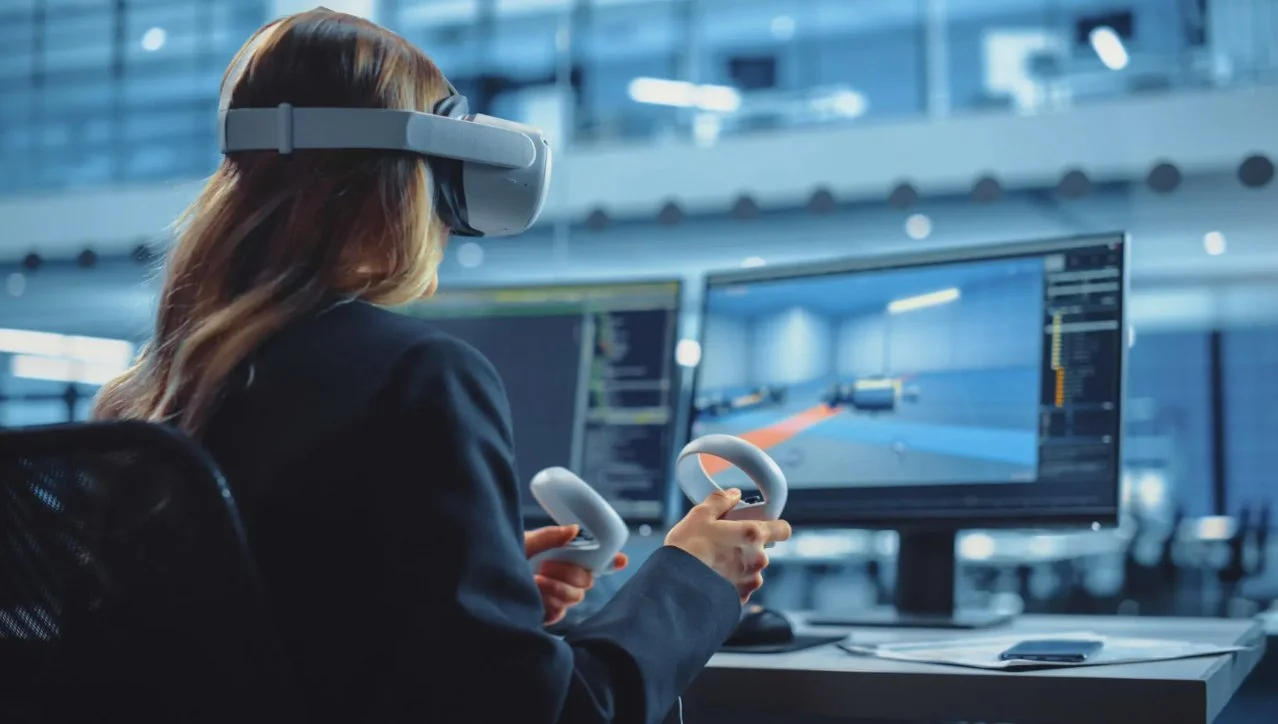
The modern workplace is changing rapidly as organizations explore new ways to connect employees, improve collaboration, and make digital work more interactive. Traditional video meetings, shared documents, and messaging platforms remain essential, but they do not always recreate the experience of working together in the same physical environment. Spatial computing is emerging as a promising approach to this challenge by combining digital information with three-dimensional spaces, interactive environments, and real-world surroundings. Through technologies such as augmented reality (AR), virtual reality (VR), mixed reality (MR), and artificial intelligence (AI), businesses can develop virtual workspaces where employees communicate, visualize information, and collaborate on complex projects in more natural ways.
The growing interest in spatial computing also reflects a wider shift toward flexible working arrangements, distributed teams, and technology-driven productivity. Instead of relying exclusively on flat screens, professionals can interact with digital objects, explore three-dimensional models, and participate in virtual environments designed around specific tasks. The innovation trends discussed through techloomz com provide a useful perspective for understanding how emerging digital technologies may influence the next generation of workplace experiences. Although adoption remains uneven across industries, spatial computing is gradually moving beyond experimentation and becoming a practical consideration for organizations looking to improve remote collaboration, employee training, product development, and knowledge sharing.
Understanding Spatial Computing in Virtual Workspaces
Spatial computing describes a collection of technologies that allow computers to understand, interpret, and interact with physical or simulated three-dimensional environments. These systems can combine information about a user’s position, movements, surroundings, and gestures to create experiences that respond to the environment. Depending on the device and application, users might see digital information layered over their surroundings, manipulate virtual objects with their hands, or enter a fully immersive digital workspace.
In a virtual workplace, these capabilities create opportunities that traditional collaboration tools cannot always provide. For example, an engineering team working across several countries could gather around a shared three-dimensional prototype and examine its components from different angles. Architects could walk clients through a digital building before construction begins, while healthcare educators could use interactive simulations to demonstrate complicated procedures. Such experiences help participants understand spatial relationships and technical details that may be difficult to communicate through photographs, spreadsheets, or conventional video calls.
Spatial computing does not necessarily mean that every employee must wear a headset throughout the working day. Some solutions use tablets, smartphones, desktop applications, or lightweight wearable displays. The most effective implementation depends on the task, the available equipment, and the degree of immersion required. As hardware and software continue to evolve, organizations are likely to combine conventional digital tools with spatial experiences rather than replace every existing workplace platform.
How Spatial Computing Is Transforming Remote Collaboration
Remote collaboration has become a central part of modern business operations, but distributed teams still encounter communication challenges. Video conferencing makes conversations possible, yet it can be difficult to demonstrate physical relationships, examine complicated designs, or maintain a shared sense of presence when participants are separated geographically. Spatial computing introduces alternative methods of collaboration by creating shared digital environments in which participants can interact with objects and information together.
Imagine a product design team developing a new industrial machine. In a traditional meeting, engineers might share technical drawings on a screen and explain individual components verbally. With a spatial workspace, team members could inspect a three-dimensional model, enlarge specific parts, identify potential problems, and discuss modifications while viewing the same object. This approach can reduce misunderstandings and make technical discussions more visual. Similar methods may help marketing teams develop product demonstrations, construction companies coordinate building projects, and educators conduct interactive lessons.
Another important development is the integration of spatial environments with existing productivity platforms. Employees may eventually move between video meetings, shared workspaces, project management systems, and immersive environments without losing essential context. However, the quality of collaboration depends on more than realistic graphics. Clear communication, accessible controls, reliable connectivity, and thoughtful meeting design remain essential. Businesses must ensure that immersive tools solve genuine problems rather than introduce additional complexity into everyday work.
Major Innovation Trends Shaping Spatial Workspaces
The development of spatial computing is influenced by advances in hardware, software, artificial intelligence, and cloud infrastructure. These technologies are becoming increasingly interconnected, creating opportunities for virtual workspaces that are more responsive, personalized, and useful.
AI-Powered Spatial Environments
Artificial intelligence can make virtual workspaces more intelligent by helping users organize information, interpret complex data, and automate routine activities. AI assistants may summarize collaborative sessions, identify important decisions, organize digital objects, or help participants locate relevant documents within a virtual environment. Computer vision can also support object recognition and contextual interactions, depending on the capabilities of the device and software.
For example, an employee inspecting a virtual machine could request an explanation of a particular component and receive relevant technical information within the workspace. A project team might use AI to summarize its discussion and generate a list of follow-up tasks. These capabilities could reduce the time spent switching between applications. Nevertheless, AI-generated information must be reviewed carefully, especially when decisions involve safety, engineering accuracy, confidential business information, or regulatory requirements.
Mixed Reality and Digital Twins
Mixed reality combines digital elements with a view of the physical world, allowing virtual objects and information to appear alongside real surroundings. This is particularly useful when employees need to work with physical equipment while accessing digital instructions, diagrams, or measurements. A technician, for instance, could view maintenance guidance while examining machinery, provided the device and application support the necessary functionality.
Digital twins extend this concept by creating digital representations of physical assets, systems, or processes. In manufacturing, a digital twin may help teams understand equipment performance, evaluate operational scenarios, and investigate potential maintenance requirements. When connected to reliable operational data, spatial interfaces can make these representations easier to explore. However, a digital twin is only as useful as its underlying data and modeling assumptions. Organizations need appropriate validation before using it to support consequential operational decisions.
Lightweight Wearables and Improved Interfaces
The usefulness of spatial computing depends heavily on how comfortable and accessible its devices become. Bulky headsets, limited battery life, restricted fields of view, and high equipment costs can discourage regular use. Consequently, lighter wearable displays, improved sensors, better battery efficiency, and more intuitive interaction methods are important areas of development.
Voice commands, hand tracking, eye tracking, and physical controllers offer different ways to interact with digital content. Each method has advantages and limitations. Voice controls can be convenient when hands are occupied, while hand tracking may make manipulating virtual objects feel natural. Eye tracking can help users navigate interfaces, although it requires careful attention to privacy and accessibility. Organizations should evaluate devices according to comfort, task requirements, and user needs rather than assuming that the newest hardware will automatically deliver the best results.
Key Applications Across Different Industries
Spatial computing is relevant to a wide range of professional activities because many business challenges involve understanding physical spaces, complicated objects, or processes that are difficult to communicate through flat displays. Its value will differ by industry, but several applications are already attracting attention.
In architecture and construction, teams can use immersive models to examine building layouts, evaluate design alternatives, and communicate proposed changes to clients. Workers may benefit from visual guidance when interpreting plans or coordinating complex installations. In manufacturing, spatial applications can support product design, equipment maintenance, assembly training, and remote technical assistance. These uses may help organizations identify design problems earlier or improve the clarity of technical instructions, although actual productivity gains must be measured rather than assumed.
Education and professional training offer another promising area. Employees can practice procedures in simulated environments before applying their knowledge in real situations. For example, industrial trainees might learn how to respond to equipment failures without putting expensive machinery or themselves at unnecessary risk. Healthcare educators can use three-dimensional visualizations to explain anatomy and complex concepts. Retail businesses may explore immersive product demonstrations, while real estate companies can offer virtual property tours to clients who cannot visit in person.
The innovation discussions associated with techloomz com can be considered in this broader context of workplace transformation. The central question for businesses is not simply whether a technology looks impressive, but whether it helps people complete meaningful tasks more effectively. Successful applications are likely to emerge where spatial interaction provides a clear advantage over existing methods.
Comparing Traditional and Spatial Virtual Workspaces
Different collaboration technologies serve different needs. Traditional tools are often more efficient for straightforward communication, while spatial environments can be particularly valuable when teams need to visualize, manipulate, or explore complex information.
| Feature | Traditional Virtual Workspace | Spatial Computing Workspace |
|---|---|---|
| Collaboration | Video calls, messages, and shared documents | Shared 3D environments and interactive objects |
| Visualization | Primarily two-dimensional screens | Three-dimensional models and spatial overlays |
| User interaction | Keyboard, mouse, touch, and voice | May include gestures, spatial tracking, and voice |
| Training | Videos, presentations, and digital courses | Interactive simulations and immersive practice |
| Equipment | Usually computers and mobile devices | May require specialized displays or sensors |
| Main consideration | Familiarity and broad accessibility | Immersion, hardware costs, comfort, and usability |
This comparison demonstrates why spatial computing should generally be viewed as an extension of digital collaboration rather than a universal replacement. A short planning meeting may work perfectly well through a conventional video call, while reviewing a complex industrial design may benefit from a shared three-dimensional environment. Selecting the right tool for each task helps businesses avoid unnecessary expense and technology fatigue.
The Role of Cloud Computing and Connectivity
Spatial applications can require significant processing power because they must render three-dimensional environments, interpret sensor information, and respond to user movements with minimal delay. Cloud computing can support these requirements by providing remote processing, centralized data storage, and access to shared digital assets. In some systems, processing is distributed between the device and cloud infrastructure to balance responsiveness, battery life, and computational demands.
Reliable connectivity is particularly important when several participants interact with the same virtual environment. Delays, interruptions, or inconsistent synchronization can make collaborative activities frustrating. Organizations therefore need to consider network performance, device capabilities, application compatibility, and data access before deploying spatial tools across distributed teams.
Security must also remain a priority. Virtual workspaces may process confidential conversations, business models, spatial maps, voice recordings, and movement-related information. Companies should establish clear policies covering data collection, retention, access permissions, encryption, and third-party services. The best technical solution is not necessarily the one with the most features, but the one that balances usability, security, reliability, and business value.
Challenges and Limitations of Spatial Computing
Despite its potential, spatial computing faces practical barriers that may slow adoption. Equipment can be expensive, and not every employee finds headsets comfortable for extended periods. Some users experience eye strain, headaches, or motion discomfort in immersive environments. Device weight, limited battery life, software fragmentation, and the need for technical support can also complicate deployment. Businesses must evaluate these issues through realistic trials rather than relying solely on demonstrations or vendor promises.
Accessibility is equally important. Employees may have different visual, hearing, mobility, or sensory needs, and an interface that works well for one person may be difficult for another. Spatial applications should provide alternative controls, readable text, adjustable environments, and ways to participate without specialized hardware wherever practical. Organizations must also avoid creating a workplace in which employees without expensive devices are excluded from important meetings or opportunities.
There are several additional challenges worth considering before implementation:
-
Financial investment: Devices, software licenses, maintenance, and training may increase total costs.
-
Employee adoption: Workers need practical guidance and a clear reason to change established routines.
-
Privacy protection: Spatial sensors and biometric-related capabilities require responsible data governance.
-
Technical compatibility: Applications must work reliably with existing business systems and security requirements.
These concerns do not eliminate the benefits of spatial computing, but they highlight the importance of gradual implementation. Pilot projects, user feedback, accessibility testing, and measurable performance goals can help organizations determine whether an investment is justified.
How Businesses Can Prepare for Spatial Computing Adoption
Organizations interested in spatial workspaces should begin by identifying tasks where three-dimensional interaction offers a meaningful advantage. Product visualization, technical training, remote equipment assistance, and complex design reviews are potential starting points. Businesses should compare the expected benefits with the total cost of equipment, software, support, and employee training. They should also define measurable objectives, such as reducing design errors, shortening training time, or improving the speed of technical collaboration.
A controlled pilot is often more useful than an immediate company-wide rollout. A business could select one department, test a small number of devices, and compare performance with its existing workflow. Employees should be involved in the evaluation because their feedback can reveal usability problems that technical demonstrations may overlook. Results should include both quantitative measures and qualitative observations, such as comfort, ease of use, and perceived collaboration quality.
Companies can also prepare by developing internal policies for security, accessibility, acceptable use, and digital asset management. As discussed in emerging technology coverage through techloomz com, innovation is most valuable when it is supported by practical planning. Businesses that understand their requirements and introduce new capabilities carefully will be better positioned to adapt as hardware and software mature.
The Future of Spatial Computing in Virtual Workspaces
The future of spatial computing will likely involve closer integration between artificial intelligence, wearable devices, cloud services, and conventional productivity applications. Rather than requiring workers to enter completely separate virtual worlds, future systems may provide spatial features when they are useful and return to familiar interfaces when they are not. A designer might review a three-dimensional prototype during a project meeting, switch to a standard document for written feedback, and then return to the model to evaluate revisions.
Another potential development is the growth of persistent digital workspaces that retain relevant project information between sessions. Teams could revisit shared models, examine previous decisions, and continue work without recreating the same environment each time. AI may help organize these spaces and retrieve relevant information, while digital twins could connect workplace simulations with real-world operations. The success of these capabilities will depend on interoperability, reliable data, sensible privacy protections, and interfaces that remain easy to use.
Adoption will not happen at the same speed across every industry. Businesses with complex physical assets or significant training requirements may find immediate value in selected applications, while organizations focused mainly on writing, administration, or simple communication may see fewer advantages. Future innovation will therefore depend on matching the technology to actual needs rather than treating immersive experiences as an essential feature of every job.
Conclusion
Spatial computing is creating new possibilities for virtual workspaces by making digital collaboration more visual, interactive, and context-aware. Through augmented reality, virtual reality, mixed reality, AI-powered assistance, and digital twins, organizations can explore improved approaches to training, design, remote support, and teamwork. These technologies may help employees understand complicated information, collaborate across geographical boundaries, and perform specialized tasks with greater clarity. However, the long-term value of spatial computing will depend on practical implementation rather than technological novelty alone. Hardware costs, employee comfort, accessibility, cybersecurity, and integration with existing systems remain important considerations. Businesses should begin with clearly defined use cases, test solutions with real users, and measure results before expanding their investments.